The long-lost Golden Rod Cake

I was looking through a 1914 issue of The Boston Cooking School Magazine when this ad caught my eye:

A couple of interesting gadgets, there. That Roberts Lightning Mixer looks useful, and the mayonnaise mixer… well, you’d have to make a lot of mayonnaise to make that one worth taking up space in the kitchen, but if you do make a lot of mayo, I can see that it could be helpful.

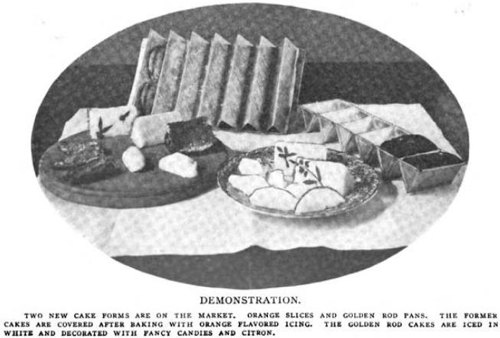
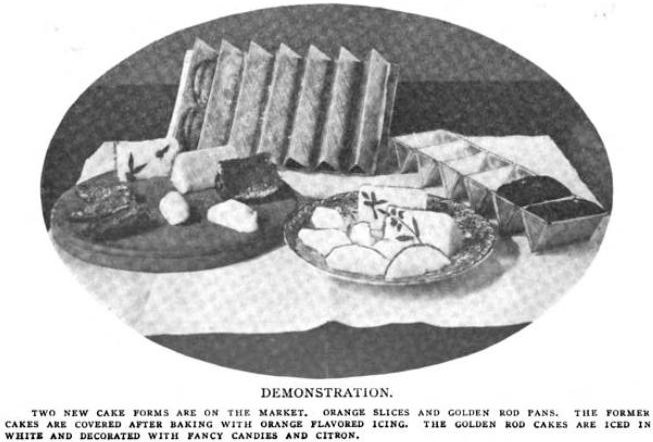
But the one that mainly caught my attention is the one at the bottom of the page: “Golden Rod Cake Pan,” an oddly-shaped pan that appears to make triangular cakes. Since the inspiration for this blog, a year ago, was the similarly-named “Gold-n-Sno Cake,” I was particularly curious. What was the Golden Rod Cake?

A quick Google search turned up this post by the Old Foodie, who looked into the topic last year, complete with three interesting recipes.

Here are a couple more recipes for the Golden Rod Cake.

First, a very sparse recipe from A Collection of Delectable Recipes: Tried and True, 1898:

GOLDEN ROD CAKE.

Eighteen ounces powdered sugar, nine ounces butter, sixteen ounces eggs, one tablespoonful vanilla, one pennyweight soda, two pennyweights cream tartar, eighteen ounces pastry flour.
MRS F.C. CHANDLER.

No instructions whatsoever. No reference to the icing that many of the other recipes have. And no orange. Is this a related cake or something different?

Here’s a pair of recipes from Perfection in Baking, 1899. The first recipe is very close to Mrs. Chandler’s recipe, above. Perhaps we can assume that Mrs. Chandler just didn’t mention the orange icing because it was assumed that any reader would know that Golden Rod cakes would have orange icing.

Golden Rod Cake.
TO SELL AT 15 CENTS EACH.

Cream together one pound of fine sugar with ten ounces of butter and one and a half pints eggs, one pennyweight of soda, one teaspoonful of vanilla, twenty ounces of cake flour, two pennyweights of cream of tartar. When baked, ice the sides with orange water icing.

Golden Rod Cake.
TO SELL AT TEN CENTS A PIECE.

With one pound of butter and lard cream one and one half pounds of sugar, ten eggs, two thirds of a pint of milk, juice and grating of two oranges, two pounds of cake flour, one ounce of baking powder. Mix and bake like above. Ice some with orange, some strawberry, some chocolate. On one side ornament the name “Golden Rod” in different colors; that is, if cakes are frosted chocolate, ornament in yellow; if iced yellow, ornament in pink or white, etc.

(Further down on the same page, there is a recipe for Orange Slices cakes baked in a particular mold, and Orange Slice Cake is mentioned in the ad for the Golden Rod Cake Pan. Is this Orange Slices recipe what was meant?)

The Boston Cooking School offered the Golden Rod Cake Pan in the pages of their magazine, so it is no surprise that they had a recipe or two for it themselves. In 1904-1905, they gave us these two slightly different variations:

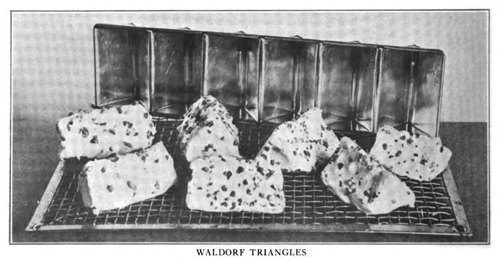
Goldenrod Cake for Charlotte Russe Moulds and Waldorf Triangles

Beat the yolks of six eggs very light. Gradually beat into these half a cup of sugar, then two tablespoonfuls of milk or orange juice, and, lastly, half a cup of sifted flour, sifted again with a level teaspoonful of baking powder and a few grains of salt. Fill the moulds or pans with a teaspoon, tapping the moulds on the table, to cause the mixture to settle to the bottom of the moulds. Bake in an oven a little hotter than for ordinary sponge cake, and turn the cake from the tins as soon as it is removed from the oven. Flavor with a grating of orange rind, or half a teaspoonful of vanilla extract. The recipe will make twelve triangles or charlotte russe cases. The mixture is finer-grained and more tender than the usual sponge cake. Cover the triangles with boiled frosting, and sprinkle with chopped pistachio nuts.

Goldenrod Cake for Charlotte Russe Moulds and Waldorf Triangles

Beat the yolks of six eggs very light. Gradually beat in half a cup of fine granulated sugar, then two tablespoonfuls of milk or orange juice (lemon juice will not do) and, lastly, half a cup and one tablespoonful (for difference in flour) of sifted flour, sifted again with a level teaspoonful of baking powder and a few grains of salt. Bake in an oven a little hotter than for ordinary sponge cake. Flavor with half a teaspoonful of vanilla extract or a grating of yellow orange rind.

Putting all this together, what we have is a fairly fine sponge cake, frequently with orange flavoring, shaped something like triangular ladyfingers, and sometimes used the same way (which might explain the lack of icing in Mrs. Chandler’s recipe—if you were making these for a Charlotte Russe, you wouldn’t need the icing).

I still don’t know the origin of the name, and I would really like to see how the Golden Rod cake was supposed to look. It would be fun to try to make them in the proper shape — does anyone know if pans like that still exist? I haven’t been able to find one.

“A Candy Receipt”: Cocoanut Cream Bars

I have a new recipe resurrection to post soon, but in the meantime, I want to link to a relevant post at The Ugly Woman’s Guide to Internet Dating (which, despite the title, has some lovely posts about old houses and kitchen topics, including one on the Monitor Top fridge, a topic of particular interest to me).

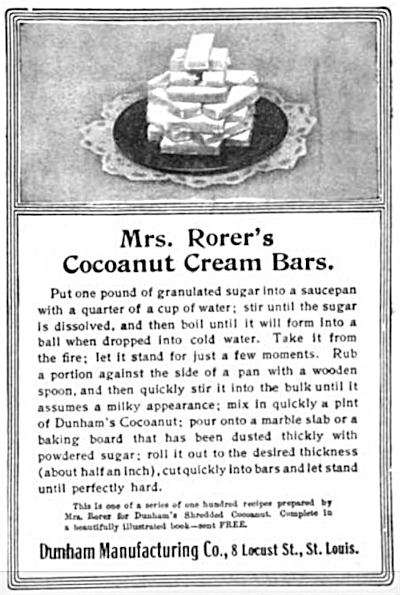
The blog author, Rose Thornton, recently posted a great 1903 ad for Dunham’s Cocoanut, with swoopy Art Nouveau lines surrounding a picture of “Cocoanut Cream Bars,” and the “Candy Receipt” that would produce the delectable desserts.

Browsing around Google Books for some more Dunham’s ads, I came across the same recipe from 1901, in a much less exuberant design—not a hint of Art Nouveau in it. This one has more text and so the instructions are fleshed out a bit more. It’s also credited to the (then) very famous Mrs. Rorer, who compiled a recipe booklet or two for Dunham’s. (Unfortunately, the ad is a bit blurry, but at least it’s still readable.)

Interestingly, while the 1903 ad uses the old-fashioned term “receipt,” the 1901 ad just says “recipe.” (Speaking of language/spelling changes, I wonder why “cocoanut” became “coconut” sometime during the 20th century.)

The recipe itself is pretty straightforward; boil a sugar syrup until it “will form into a ball when dropped in cold water”—soft ball stage, 235° F–240° F. Then remove it from the heat, let it stand briefly, and then stir it against the side of the pan with a spoon, which should give you some crystallization. Then stir it all together and mix in the coconut quickly. (Judging from some of my previous experiences making a very similar old-fashioned fudge recipe, they aren’t kidding when they tell you to work quickly here. The stuff can thicken up fast.) It should be tasty, if tooth-achingly sweet.

Christmas might be a good time to try this one. If you do, please share how it went.

Orange Omelets: “for ruffians and brazen harlots”

Photo by Vincent van Dam.

Photo by Vincent van Dam.

Those who know me know well that I love citrus flavors. Particularly citrus desserts. Lemon cake with raspberry filling. Lemon curd. The elusive “Gold-n-Sno Cake.” So when browsing late 19th century magazines, the phrase “Orange Omelet” leapt out at me. I had to try it. Oranges, sugar, and eggs — sounds lovely. When do we eat?

You can still find sweet orange omelets here and there, but they are decidedly old-fashioned. None of my modern cookbooks contain one, but they are frequently found in classic late 19th/early 20th century cookbooks such as Fannie Farmer’s Boston Cooking-School Cook Book, The Settlement Cook Book, and Mrs. Lincoln’s Boston Cook Book.

The orange omelet, however, goes back a lot further than that — at least to the 1430s, when Johannes Bockenheim, cook to Pope Martin V, published this recipe in his cookbook:

How to make an orange omelette

Take eggs and break them, with oranges, as many as you like; squeeze their juice and add to it the eggs with sugar; then take olive oil or fat, and heat it in the pan and add the eggs. This was for ruffians and brazen harlots. (“Et erit pro ruffianis et lecceatrichus.”)

Ruffians and brazen harlots? Well, call me a brazen harlot, then.

Bockenheim’s recipe is not terribly different from those that followed about 100 years ago.

Good Housekeeping, February 1898:

An American Omelet.
Make an omelet of four eggs, the yolks and whites beaten separately, four tablespoonfuls of sugar, a pinch of salt, grated rind of one orange and three tablespoonfuls of orange juice, fry. The instant the omelet is cooked, spread the sliced oranges on it and fold or roll the omelet. Serve very hot.

Parisian Orange Omelet.
Take the whites and the yolks of four eggs beaten separately, very thoroughly. To the yolks add three tablespoonfuls of sugar, not more than a pinch of baking powder, two tablespoonfuls of flour, four of milk, one tablespoonful of orange juice. Pour into a heated saucepan, then the whites, fry rapidly, fold, serve very hot with raspberry jam. A delightful luncheon dish.

Good Housekeeping, March 1898:

Orange Omelet.
Four eggs, five tablespoonfuls of sugar, a little salt, two oranges, two tablespoonfuls of butter. Grate the rind of one orange on one tablespoonful of sugar. Pare and cut the orange in thin slices and sprinkle with two tablespoonfuls of sugar. Beat the whites of the eggs stiff, add the sugar and orange rind, salt, beaten yolks, and two tablespoonfuls of orange juice. Put butter in a hot omelet pan and pour in the mixture. When it begins to thicken well, spread over the sliced oranges (no juice). Fold omelet from the side of the pan over the sliced oranges, turn on a hot dish; put in the oven two minutes, and serve immediately.

Then, about 20 years later in The Way to a Man’s Heart: The Settlement Cook Book (about which I will be posting more soon):

Orange Omelet.
Rind of 1/3 orange,
1 egg,
1 tablespoon orange juice,
2 tablespoons powdered sugar.
Beat the yolk of the egg and add the orange rind and juice. Add the sugar. Fold in the beaten white and turn on heated buttered pan and cook until set. Serve with powdered sugar.

I tried the last recipe yesterday — it’s simple, and serves one, which is nice when I’m experimenting. Watch this space tomorrow for the results.

Welsh rabbit redux

One more try at the Welsh rabbit. Photo by Wendi.

One more try at the Welsh rabbit. Photo by Wendi.

Months ago, one of the first recipes we tried for this blog was Welsh rabbit (or rarebit), an old-fashioned dish I’d always been curious about but never tried. It did not turn out well. But it seemed clear (to me, at least) that it was a comedy of errors on our part (including the death of our oven in mid-cook, and our failure to deal with it correctly) that probably led to the recipe’s failure, and I vowed to try it again. Now I have a working stove and oven, so the time seemed to be right.

In the comments for the last Welsh rabbit post, reader Lynn wrote:

Do try the rarebit again…it is delicious. I serve it over a bowl of nice bread, cut as for fondue, with steamed broccoli and some nice red bell pepper strips. Quick, pretty inexpensive and really good on a winter night.
Here are my notes: Use a double boiler and cook out the roux first, beat the egg into the beer and thin the roux with this, then melt in the cheese. Foolproof.

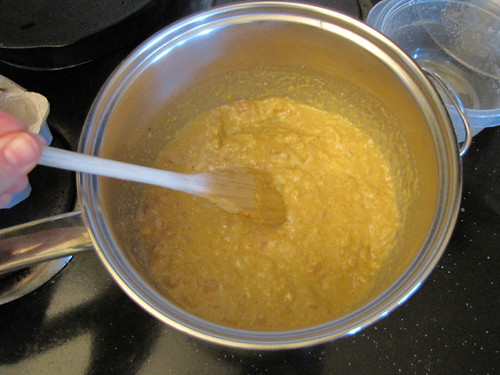
We took her advice, using our recipe but her directions. The ingredients were the same, except that we used Buzzsaw Brown Ale instead of Newcastle. We used a metal bowl as a double boiler, and this time the rabbit sauce was dead easy to make and no trouble whatsoever. Lynn was right!

Although we now have a working oven again, I was taking no chances — I just toasted the bread in the toaster this time, playing it safe.

For a side dish, I served a salad with a sweeter balsamic vinaigrette dressing to balance out the salty savoriness of the Welsh rabbit. It worked perfectly.

Kristen wasn’t here that night, and is skeptical that the Welsh rabbit can be good after all, so I’ll be making this again for her to try. The men in the house loved it, though.

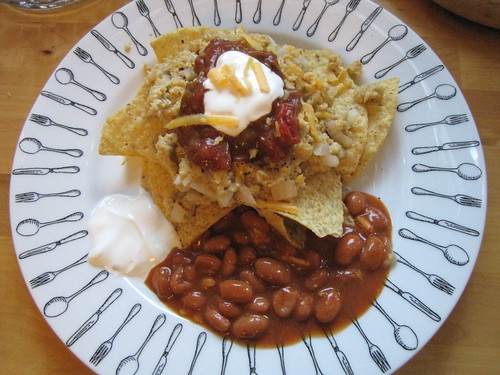
The lighting wasn’t great by this time of night (do all the other food bloggers do their cooking in the daytime or something?), but I did get a picture of the finished product:

Welsh rabbit -- in poor lighting

Compare this with the picture here, and it’s obvious this was a much more successful experiment. Thanks, Lynn!

The Welsh Rabbit experiment
The finished product; not very pretty, but it tasted good -- to some of us

The finished product; not very pretty, but it tasted good -- to some of us

(This is part 2 of the Welsh Rabbit story. See Part 1 for the background.)

Kristen and I gathered at the house tonight to make our Welsh Rabbit. Kristen brought Caesar salad to eat along with the “rabbit.” Jason was there to help eat the food.

The recipe we decided to use, as I mentioned earlier, was from the Good Housekeeping Woman’s Home Cook Book, exactly 100 years ago in 1909. They claim that all the recipes in that book are triple-tested, so we are hoping that this well-tested recipe works for us. Here it is:

A Really Digestible Welsh Rarebit

Melt one tablespoon of butter, add one-fourth of a teaspoon of salt and paprika, half a teaspoon of dry mustard and one-third of a cup of ale or beer. Stir constantly, and when hot, put in half a pound of cheese cut into small pieces. As it gradually melts it may thicken, for no cheese is exactly alike in the amount of liquid it requires. If it seems too thick, add more beer. If the rarebit is preferred creamy instead of stringy, add one beaten egg just before serving. The paprika in this recipe makes the cheese mixture perfectly digestible. If the regulation toast is not at hand for serving rarebit, pour it over saltines.–I. G. C.

This is not too difficult a group of ingredients to assemble. For the cheese, we picked up some Coastal Rugged Mature English Cheddar Cheese at Costco, and it’s really tasty stuff. Yum. For the ale, we got Newcastle Brown Ale. For the toast, we had some rolls from the local bakery — probably not exactly what was intended, but they were fresh and seemed as if they’d make fine toast. I got all the ingredients together, sliced the rolls and put them on a baking sheet, turned on the oven to toast the rolls, and was ready to start cooking.

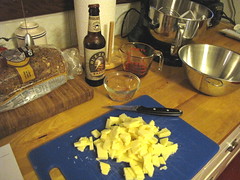
Some ingredients waiting to be made into tasty sauce

Some ingredients waiting to be made into tasty sauce

I melted the butter, and then added the spices and beer. So far, so good. I wanted to get the rolls toasting so they would be perfectly toasted right about the time the sauce was done. But first, I put the cheese in the pan. This was probably a miscalculation. As I stirred the cheese, Kristen opened the oven to put the rolls under the broiler, and… the oven was cold.

Broken, that is. The knob had been turned on correctly, but nothing happened. I continued stirring the cheese, and the sauce looked about perfect… but we had nothing yet to pour it on. Jason came in and twiddled with the oven and got it to come on. Then it turned itself off. Then Jason got it to go back on again. The rolls were finally toasting… and right before our eyes, the cheese sauce started to separate. We cooked it too long, I think.

We added the beaten egg as the recipe optionally calls for, but we still had an ugly-looking stringy mess. Smelled good, though.

Shortly after we poured it on the toasted rolls, sort of. The thickest parts sort of glopped on. Kristen said it was “unappetizing.” We dished up our salads and settled down to eat.

The verdict:

Wendi: Thought it was ugly, and obviously not what it was supposed to look like, but it actually tasted pretty good anyway. Kind of salty, though. Would be willing to try it again.

Kristen: Hated it. Would not try it again. Thought it was too salty.

Jason: Liked it and would definitely eat it again. Enjoyed the leftover brown ale with it, too.

If I try this again, and I probably will, I will probably just toast the bread in a toaster, and heat the sauce under much lower heat, so it would not cook as quickly. Since it was a chafing-dish meal in the first place, I really should have done that all along. (What was I thinking? This was pure cook’s error. I would have gotten away with it if not for those meddling kids if I’d taken the sauce off the burner as soon as it looked right, though.) Also, I would probably not add all the salt in the beginning, and would salt to taste a bit later, which might help with the saltiness Kristen and I noticed. The aged cheddar seemed particularly salty in flavor to start with. This may be something that varies with different cheeses, I think. Other recipes I’ve seen include a little flour; I wonder if that would make the sauce a bit more manageable.

Having anchovies in the Caesar salad with it did not help as far as saltiness is concerned! Something to balance out the salt would be nicer as a side dish. Maybe a sweeter salad dressing?

I think one of the reasons that this dish has fallen by the wayside in recent years is the fussiness of making the cheese sauce. The average American household, sadly, is probably more likely to open a can, or just have a toasted cheese sandwich when it comes down to it.

(Psst — here’s a page with some lovely photos of what the Welsh Rabbit should really look like. If I’d gotten ours off the burner a little sooner, it would have looked like that too.)

RECENTLY

ARCHIVES

Links

Recent Comments

Tags

1400s 1820s 1890s 1900s 1920s 1930s 1950s asparagus aspic betty crocker cake cheese chocolate citrus cookbooks dessert dips eggs ge gelatin holidays kitchenaid kitchen technology malted milk medieval mexican cookery mixer monitor top nostalgia omelets oranges party food period kitchens pink porridge pub food puddings rarebit refrigerator remodel salads snacks spring stove thanksgiving


AUTHORS

  • profileWendi is a history geek and loves to bake, particularly recipes from her grandmother's collection. Kristen has been cooking her whole life. She has a BS in Family & Consumer Science and enjoys comfort foods and creating new recipes.

FLICKR

  • www.flickr.com
    This is a Flickr badge showing public items from the Resurrected Recipes group pool. Make your own badge here.

Potential projects

  • Malted Milk Cake (1920s-1930s)
  • English Monkey (1930s)
  • Ginger Ale Salad (1920s)
  • Homemade pop (soda)
  • Mayonnaise Cake or Surprise Cake (1930s)
  • Raspberry Cream in Pineapple Shells (1909)
  • Cream cheese/sesame party dip (1960s)
  • Welsh Rabbit (1909)
  • Gold-N-Sno Cake (1933)
  • Orange Omelet (1920s)
  • "Mock Egg" cake (1900s-1940s)
  • Tomato Jelly Salad (1930)
  • Molasses Cake (1930)
  • Peanut Butter Rarebit (1920)
  • Tablet (1900s-1910s)
  • Asparagus on Toast (1930s)