Oh, Mapleine! (2 of 3)

The Northwest is beginning to stir, however. The Crescent Manufacturing Company changed the needle on the victrola when it demonstrated that Mapleine was desired by national retailers as soon as they learned of it through the national advertising campaigns started twelve years ago. In 1910 Mapleine advertisements appeared in Good Housekeeping, The Designer, Women’s Home Companion, Ladies’ Home Journal, and Ladies World. Carnation Milk used a loud toned needle, and became a national product about the same time.
– “Advertising Matters,” The Washington Newspaper, May 1923.

In Part 1 of our series about Mapleine, I gave you some of the background of the product and the Crescent Manufacturing Company’s battle with the US government over labeling. After they made a deal with the Feds that allowed them to keep using the name Mapleine, there was no holding them back. As the above quote indicates, they started advertising nationally, and Mapleine took off.

The first part of the 20th century saw two World Wars and a Great Depression. A product that allowed homemakers, campers, and all other maple fans to make syrup that tasted good but was much cheaper than true maple was perfect for the times, and Crescent made darned sure everyone knew it.

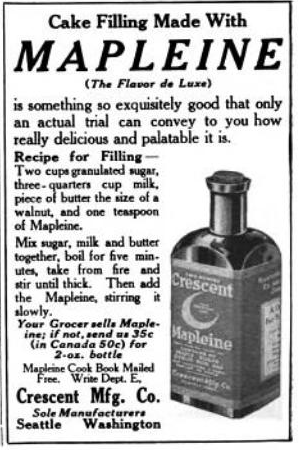
In the early 1910s Mapleine was promoted as “The Flavor De Luxe.” Ads, then and later, often featured recipes. Here’s a 1912 ad from Literary Digest with a simple recipe for cake filling.

Literary Digest, 1912


Mapleine Cake Filling

  • 2 cups granulated sugar
  • 3/4 cup milk
  • walnut-sized piece butter
  • 1 teaspoon Mapleine

Mix sugar, milk and butter together

Boil for five minutes

Take from fire and stir until thick.

Then add the Mapleine, stirring it slowly.

(more…)

Strawberry festival season

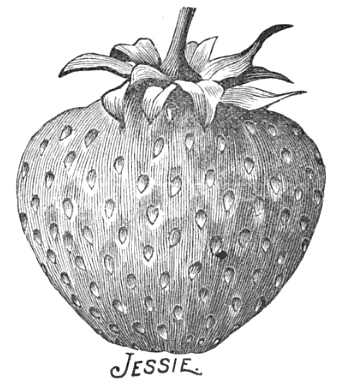
Jessie: a strawberry variety illustrated in The ABC of Strawberry Culture for Farmers, Village People, and Small Growers, by T. B. Terry and A. I. Root, published in 1902.

It’s June, which means that it’s strawberry season! (Well, usually it is. This year, the Northwest weather has been unusually cold, and so I bet the strawberries are running late.) If it’s strawberry season, it’s time for a strawberry festival, with some strawberry recipes and menu ideas!

110 years ago in June 1901, Good Housekeeping published “XXth Century Festivals: The Strawberry Festival,” suggesting that festivals should be held on a moonlit evening and furnished with tables with fine white linen tablecloths and fern decorations. The dishes should be strawberry red, green, and white.

The suggested centerpiece (which “should have a place of honor”) sounds quite lovely for a summer twilight party:

“In a conspicuous place set a table holding a glass bowl of strawberry frappe or lemonade, to be served in small glass cups. A block of ice hollowed out, with a lighted pink candle inside, may be put in the center of the bowl, and the frappe heaped around the ice, insuring coolness. Decorate the table with strawberry vines or ferns, and have two white-robed maidens to serve the frappe.”

Here is the recipe given a few pages later for the frappe:

Strawberry Frappe

  • 4 cups water
  • 2 cups sugar
  • Juice of 6 lemons
  • 4 cups mashed fresh strawberries

The following recipe makes a very delicate frappe. Boil for fifteen minutes four cups of water and two cups of sugar, add to it the juice of six lemons and four cups of mashed fresh strawberries or one quart of the canned fruit.

Allow it to cool, strain and add one quart of ice water.

Freeze to a mush, using equal parts of ice and salt.

If you use canned fruit which is very sweet the frappe may not require so much sugar.

Good Housekeeping‘s suggested menu for the event might be slightly different from a modern menu, but not terribly so:

STRAWBERRY FESTIVAL MENU

Cold ham    Cold tongue    Rolls
Saratoga potatoes    Tomato salad    Crackers
Pickles    Radishes    Pimolas
Individual sweet shortcakes    Strawberries and cream
Strawberry ice cream    Strawberry eclairs
Sponge cake    Angel cake    Small cakes
Coffee     Chocolate

The magazine also provided some recipes for cakes and preserves to sell at the festival. Here is one example:

Strawberry Eclairs

  • 1 cup boiling water
  • 1/4 cup butter
  • A speck salt
  • 1 cup flour
  • 4 eggs
  • sweetened strawberries or jam
  • boiled icing colored with strawberry juice

Boil together in a saucepan one cupful of boiling water, one-fourth cupful of butter, and a speck of salt.

As it begins to boil stir in one cupful of sifted flour.

Stir constantly until the mixture leaves the sides of the pan and cleaves together in a ball.

When partly cool add four eggs, beating them in one at a time.

Drop carefully in long narrow strips, some distance apart, on buttered tins, and bake in a moderate oven until well risen---about thirty minutes.

Leave the oven door open a few minutes before removing the eclairs, to prevent their falling.

When they are cool split one side, fill with sweetened strawberries or jam.

Spread with boiled icing colored with strawberry juice.

I plan to try this one and will report back.

(Editorial note 1: Pimolas appear to be what we’d probably call pimientos today — olives stuffed with sweet peppers. Perhaps the word is a portmanteau of “pimiento-olives”? Many menus of that period list them as “pim-olas.”)

(Editorial note 2: The formatting of the recipes is intended to be compatible with Google’s new Recipe View system. Though the formatting is slightly different than the 1901 original, the wording of the recipe instructions is unchanged.)

More Mexican Cookery for American Homes

Don’t worry, parts 2 and 3 of “Oh, Mapleine!” are coming soon. But I found a couple more things that I thought would be of interest, and didn’t want to wait to post them.

Last year I posted about the cookbook Mexican Cookery for American Homes (1936 edition), and later tried a recipe from the book for “Enchiladas, Mexican Style” that turned out to be excellent.

Flickr user Eudaemonius has posted a complete version of the 1932 edition of the same cookbook. It is much more colorful and flamboyant in design than the 1936 copy I have—mine, perhaps, reflects a bit more Depression-era austerity. It doesn’t include the bilingual titles that the later edition contained. The 1932 copy also does not contain all of the recipes. It may be shorter (I can’t find mine to double-check at the moment), but it definitely doesn’t include the stacked enchiladas I made from the other book. It does have recipes such as “Mexican Rarebit,” “Chili and Rice Cones,” and “Mexican Chop Suey.”

Yes, you read that correctly. Here you go!

MEXICAN CHOP SUEY

  • 4 T. butter
  • 2 small onions, chopped
  • 3 pieces celery, chopped
  • 1 green pepper, chopped
  • 1 lb. hamburger
  • 1 No. 1 can tomato puree
  • 1 t. salt
  • 1 No. 2 can Gebhardt's Spaghetti

Cook onions, celery and green pepper in butter until tender; add hamburger and continue cooking until partially done.

Add tomato puree, salt and simmer until meat is tender.

Turn into a greased casserole, cover with contents of No. 2 can Gebhardt's Spaghetti and Chili and bake in moderate oven 20 min.

Mexican? Probably not so much. But it reminds me of some of the casseroles my mom cooked in the 1970s.

One other site I wanted to point you to is La Cocina Historica, a project of the University of Texas at San Antonio Special Collections Department. The blog features recipes from the university’s Mexican Cookbook Collection. They have more than 900 Mexican, Texan, and Southwestern cookbooks in Spanish and English, dating from 1789-2010. The collection includes printed cookbooks and also handwritten manuscripts. The bloggers (multiple people contribute to the site) try out the recipes and describe how they turned out.

I think “Huevos al Estilo Español” (1908) sounds lovely, but that’s probably because it’s pretty close to my breakfast burrito recipe already. I’d just mix up that filling and wrap it in tortillas.

(Editorial note: This post was changed slightly on May 17, 2011 to include new recipe formatting to be compatible with Google’s Recipe View system.)

Oh, Mapleine! (1 of 3)

Imitation flavorings tend to be frowned upon these days, or, at least, not respected very much. No one wants “chocolate-flavored” candy if they can have real chocolate instead. But there is one imitation flavor that is commonly eaten without complaint in the US and Canada — maple.

The “maple” syrup that most people have on their pancakes and waffles isn’t made of maple at all. (In the US, if the label calls it “maple syrup,” it’s supposed to be 100% pure maple. But the majority of syrup sold in grocery stores is plain old “pancake syrup,” and that’s the artificial stuff.) It tastes reasonably similar to maple syrup, and it’s fine for what it is, but it’s still an imitation. Most grocery store pancake syrups, as you can see here on the Aunt Jemima website, are corn syrup with added colorings, preservatives, and natural and artificial flavorings.

Throughout the 20th century, however, many homemakers made a much simpler artificial maple syrup with only three ingredients: granulated sugar, water, and the flavor extract Mapleine.

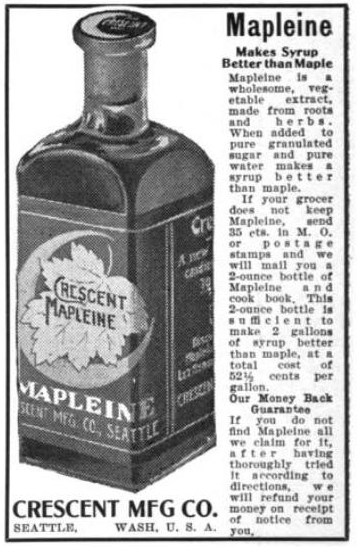
Mapleine was (and is) a product of the Crescent Manufacturing Company in my hometown of Seattle, Washington. In 1905, a Crescent chemist invented Mapleine, “a wholesome, vegetable extract, made from roots and herbs” (according to a 1906 ad in The Pacific Monthly, pictured on the right). The formula has always been secret, but a modern Mapleine package lists the following ingredients: “Water, natural flavorings, caramel color, alcohol (7%), phosphoric acid, vanillin, and sulfiting agents.”

1906 ad, The Pacific Monthly

In the product’s early years, Crescent did not (perhaps) communicate quite as well as they could have that Mapleine was, in fact, not maple at all. For example, the package pictured in the Pacific Monthly ad features a large maple leaf in the design, and does not mention at all on the front that the flavor is not real maple. One of the earliest ads for Mapleine, from a 1905 issue of The Pacific Monthly, calls it “The new Maple Sap,” with no mention of its artificial nature.

The United States government took issue with Crescent’s packaging, and in 1909, the case of The United States of America vs. 300 Cases of “Mapleine” ended up in court. The government charged that the cases were illegally labeled “Crescent Mapleine” on the outside, and that those words would indicate that the product contained maple. Crescent contended that the labeling on the cartons and bottles inside the cases, which stated “Mapleine, a Vegetable Product Producing a Flavor Similar to Maple,” should be taken into consideration. (This defense of Mapleine from a local Seattle perspective, from a 1909 issue of The Coast, is interesting reading.)

A jury found Crescent guilty of misbranding, after which the company reached an agreement with the government that the name “Mapleine” could continue to be used, as long as all labeling was modified to plainly show that the product was an imitation maple flavor. The modifications were made, and Mapleine stayed on the market.

This 1908 ad, published during the same month in which those 300 cases of Mapleine were seized in Chicago on the charge of misbranding, shows that Crescent was already taking pains to clearly label the bottles and ads. The ad leads with the not particularly enticing paragraph “Mapleine has nothing to do with maple syrup—except the flavor. Neither is it a substitute or even an imitation of maple syrup but an original flavoring with the Genuine Maple Flavor.” The bottle pictured now contains a clear disclaimer.

In 1909, Crescent hosted a large Mapleine display at the Alaska-Yukon-Pacific Exposition in Seattle, and described Mapleine, perhaps with a bit of exaggeration, as a “household word” that “spread the fame of Seattle throughout the Western hemisphere.” The booth at the A.Y.P., standing between booths for Carnation Milk (also a local product, at the time, but currently owned by Nestle) and Jell-O, was proudly marked “Seattle, Wash.” in large letters.* Mapleine is still sold today, but Crescent was sold to McCormick and Company, Inc. of Baltimore, Maryland in 1989, and Mapleine no longer promotes Seattle on its packaging.

In the next few decades, wartime and depression frugality—along with a lot of advertising and recipe booklets from Crescent—caused Mapleine to grow even more popular. In Part 2 of this series, I’ll post advertising and recipes from Mapleine’s heyday; in Part 3, I’ll make a Mapleine Pie.

Crescent's Mapleine display at the Alaska-Yukon-Pacific exposition in Seattle, 1909.

*(Editorial note added after this post was published.) On further examination of the picture, it seems possible that the “Seattle, Wash.” lettering on the booth was added to the photo after retouching. However, I cannot be certain of this. The University of Washington has a photo of the same booth, but not only has that area of the booth been clearly retouched in the UW copy, but there are some other small differences that make it seem likely the photos were taken at different times, so the UW photo does not necessarily confirm anything.

Cold and, um, clammy

I have a certain interest in old recipes for sundaes and sodas from the soda fountain era. Along with the familiar chocolate sundaes and banana splits that we still find in today’s restaurants, you find more unusual confections such as a Rose Bud Sundae with rose dressing, a Grape Sundae Malted with grape juice and malted milk, and a Fruited Creme de Menthe Salad with lettuce leaves, vanilla ice cream, fruit salad, and creme de menthe syrup.

The above are a bit unusual to modern tastes, but they don’t seem all that strange, really. (Or maybe I’m just too used to browsing old cookbooks.) But then, I came across this soda recipe in The Standard Manual of Soda and Other Beverages, 1897:

Clam-Juice Soda.

  • Clam juice, 1 1/2 fl. oz.
  • Milk, cold, 2 fl. oz.
  • Carbonated water, coarse stream, sufficient to fill an 8-ounce glass

Add a pinch of salt and a small amount of powdered white pepper to each glass.

Obviously this is not a sweet dessert. Anyone dare to try it and report back? I don’t think I can do it.

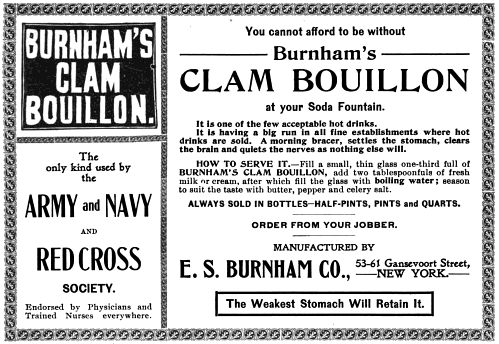
I have seen quite a few recipes for hot drinks with clam bouillon, milk or cream, and hot water (see the old ad below), and that doesn’t seem as weird—it just seems like soup. But the cold, carbonated clam soda?

Clam bouillon advertised in The National Druggist, 1900.

More Christmas menus

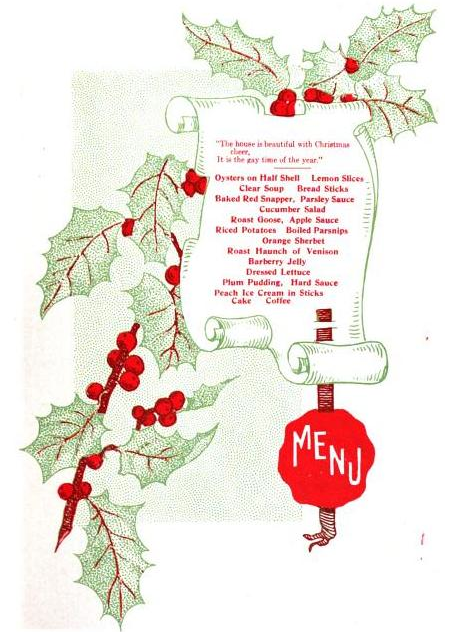
The above recipe is from Modern Housekeeping, December 1905. You may find it hard to read. Here’s what it includes:

Oysters on Half Shell     Lemon Slices
Clear Soup     Bread Sticks
Baked Red Snapper, Parsley Sauce
Cucumber Salad
Roast Goose, Apple Sauce
Riced Potatoes     Boiled Parsnips
Orange Sherbet
Roast Haunch of Venison
Barberry Jelly
Dressed Lettuce
Plum Pudding, Hard Sauce
Peach Ice Cream in Sticks
Cake     Coffee

In December 1901, American Kitchen magazine provided four separate menus for Christmas dinner. Raw oysters, Lobster Newburg and Broiled Quail are included alongside the roast turkey we are more familiar with at Christmas today. Here they are, formatted as they were in the magazine:

GRAPE FRUIT.
CHICKEN CONSOMME.       SALTED ALMONDS.
LOBSTER NEWBURG.
BROILED QUAIL.        MUSHROOM SAUCE.
PINEAPPLE SHERBET.
ROAST GOOSE.        CHESTNUT STUFFING.
APPLE SALAD.        SWEET POTATO CROQUETTES.
PLUM PUDDING.
MARLBORO PIE.        NUTS.        RAISINS.
COFFEE.

OYSTER SOUP.
CELERY.        OLIVES.        BROWNED WAFERS.
ONION STUFFING.       ROAST GOOSE.        APPLE SAUCE.
GLAZED SWEET POTATOES.        TURNIPS.
LEMON ICE.
CHICKEN CROQUETTES.
APPLE AND CELERY SALAD.
PLUM PUDDING.        MINCE PIE.
LEMON JELLY.        LEMON QUEEN CAKES.
NUTS.        DATES.        COFFEE.
APPLES.        ORANGES.

RAW OYSTERS.
JULIENNE SOUP.        CELERY.
ROAST PIG.        STUFFED POTATOES.        ONIONS.
APPLE SAUCE.
BOILED TURKEY.        POTATO CROQUETTES.
MOLDED SPINACH.
WAFERS.        LETTUCE SALAD.        CHEESE.
NEAPOLITAN CREAM.        CAKE.
COFFEE.

RAW OYSTERS.
CONSOMME.        ROLLS.        CELERY.        OLIVES.
ROAST TURKEY.        MASHED POTATOES.
SQUASH.        ONIONS.        BROWNED SWEET POTATOES.
PINEAPPLE SHERBET.
TUTTI FRUTTI.        CRANBERRY JELLY.
MINCE PIE.        PLUM PUDDING.
GRAPES.        FIGS.        DATES.
NUTS.        CANDY.
ORANGES.        APPLES.
COFFEE.

Lastly, vegetarianism is not new. Meatless Cookery by Maria McIlvaine Gillmore was published in 1914, and includes several holiday menus, such as:

CHRISTMAS MENU
Salpicon of Fruit
Tomato Bisque       Rice Biscuit
Radishes      Pine Nuts       Ripe Olives
Curried Vegetables       Sauce       Diced Cucumbers
Potatoes à la Maître d Hôtel
Spanish Onions       Cranberry Sauce
Apple and Celery Salad       Wafers
Caramel Ice Cream       Assorted Fruit       Creamed Cheese on Wafers

Perhaps some of these menus will inspire you to add old-style Christmas food to your holiday meals this year.

An all-American Christmas dinner, 1914

Browsing through Google Books (something I spend far too much time doing), I stumbled on an interesting article from a 1914 issue of American Cookery. At the time, World War I had newly broken out in Europe, but the United States remained officially neutral.

In this article, an American family declares war on expensive imported foods and converts the previous year’s Christmas menu to an American-grown feast for 1914. Consistent with the nation’s stand of neutrality, all traces of foreign content are removed, even the English plum pudding and the French word “menu.” But even in 1914, Americans couldn’t do without their coffee.

Censoring the Christmas Dinner

By Stella Burke May, American Cookery, December 1914

A state of war existed in the hitherto peaceful household of the American John Smith, for Mrs. John Smith, generalissimo of the kitchen, had declared war on foreign food products.

Among the causes which led to this declaration were, first; that the Smith household was being constantly menaced by the air fleet of Imported Products, which had dropped a High-Cost-Of-Living bomb on its commissary department, and second; that foreign invasion, during the past twelve months, had well-nigh wrecked the John Smith treasury.

In proof of this latter accusation, Mrs. Smith produced her Christmas menu from the previous year, which showed the foreign element in strong supremacy.

Feeling the need of support from a strong ally, she called her husband from his evening newspaper, and showed him the line-up of his last year’s Yuletide dinner.

“Shades of the Father of His Country,” exclaimed John as he glanced over the card. “No wonder they had war in Europe!”

This is what he read:

Christmas Dinner, 1913
Anchovy Canapés
Mushroom Consommé
Salted Wafers     Celery     Spanish Olives
Broiled Smelts     Maitre d’hôtel butter
Roast Turkey     Plain Dressing     Duchesse Potatoes
Buttered Brussels Sprouts
French Peas     Creamed Onions     Cranberry Frappé
Chinese Celery     Prune, Apple-and-Nut Salad
Neufchatel Cheese
English Plum Pudding     Hard Sauce
Mandarin Oranges     English Walnuts     Malaga Grapes
Café Demi-Tasse

So, even as the European press censor, pencil in hand, goes over his war dispatches, deleting a word here, a phrase there, lest his own particular country appear at a disadvantage or the enemy profit by the context, did Mrs. John Smith go over her Christmas bill of fare, eliding every foreign combination and condiment, and steering clear of the high C’s of yester-year such as “canapés, consommés and cafés,” this American censor effaced all evidence of foreign domination, and launched her transport upon neutral waters from cocktail to coffee.

With patriotism coupled with ingenuity, she set herself to the task of preparing a dinner that might stand uncovered as the flag goes by.

“I will avoid even the appearance of partizanship (sic),” she told herself, “and not even call this a menu. It shall be a bill-of-fare this year.”

“And there must be no foreign flavor, no paprika, no French or Italian olive oil in the salad, no imported wines or brandies.”

They both agreed that a canapé was decidedly contraband, and while it might serve if disguised under the title of “appetizer,” felt that Baltimore oysters served on their native shell, with Iowa horseradish, Oklahoma catsup, and thin slices of California lemon would be in strict neutrality.

The consommé must become a soup; not even a bouillon, but a plain vegetable soup, and asparagus seemed to meet all the maritime laws.

If the market afforded fresh radishes, they would be added to the soup course, but in no event would Spanish olives pass muster. In fact all “hors d’oeuvres” were now “hors de combat.”

The fish course was abandoned as an extravagance, since oysters were to open the meal, so the maitre d’hôtel butter was thus disposed of.

“How would it be to buy the turkey on the ‘hoof’ this year?” queried her husband. “I will kill and dry-pick it and you can hang it in the refrigerator for a couple of days before Christmas.”

“Turkey! Turkey!” exclaimed his wife in supreme astonishment. “Why, John Smith, we’re not going to have a fowl with a foreign name like that. We’re to have roast goose, with chestnut stuffing.”

For the main course, then, it would be roast goose, with chestnut stuffing and potatoes.

“Remember,” cautioned John, “there will be no vegetable with a foreign name like Irish potatoes.” So avoiding the belligerent waters in which sailed “‘potatoes a la Hollandaise,’ French fried, German fried, au gratin, O’Brien, Hongroise” she landed at sweet potatoes, Southern style, and added this to her card.

Brussels sprouts came under the same indictment. “I always have thought Brussels sprouts are just sort of ‘babes-in-the-wood’ cabbages that lost their way, so I think we will just have creamed cabbage and be done with it.”

“Onions ought to pass without an investigation,” John said, as he watched her writing “baked onions,” “but be sure they’re not Bermudas and have no foreign flavor.”

Next, cranberry frappé was shorn of its alien looks and appeared in homespun as “cranberry jelly moulded,” and the understanding was that they were to be Wisconsin grown.

Small light rolls made with Minneapolis flour would be served with the meat course.

The salad course was quickly disposed of. Following the dinner of the previous year, she chose a salad of apples, celery-and-walnuts in heart lettuce cups. She would insist on New York Jonathan apples, Michigan celery, Illinois walnuts and Florida lettuce, served with a cream dressing. In place of the Neufchatel cheese, she would serve cottage cheese spread between thin slices of brown bread, along with the salad. The “yellow peril” celery was, of course, taboo.

“I don’t see why they always have English plum pudding, when New England minced pie contains all the ‘stuff that dreams are made of,’” said John, and, his Commissary General agreeing with him, resolved to have New England minced pie with frozen pudding.

For nuts she selected Georgia paper-shell pecans. These, with Florida tangerine oranges and California raisins would seem sufficiently “censored.”

And, lastly, of course, coffee in half cups, with Louisiana cut-loaf sugar and home-grown cream. She realized she must call upon her neighbors in South America for the coffee, but they both agreed that Brazil coffee in a Connecticut percolator should pass the most captious critic.

Assembling her national dinner, this was what she produced:

Christmas Dinner, 1914.
American Plan.

Baltimore Oysters on Half Shell
Served with horseradish, catsup and thin sliced lemon
Asparagus Soup
Salted Wafers     Fresh Radishes
Roast Goose
Chestnut Stuffing
Alabama Sweet Potatoes, Southern Style
Baked Onions     Creamed Cabbage
Cranberry Jelly in Moulds
Small Light Rolls
Apple-Celery-Walnut Salad in Heart Lettuce Cups
Brown Bread-and-Cottage Cheese Sandwiches
New England Minced Pie
Frozen Pudding
Florida Tangerines     Georgia Paper Shelled Pecans     California Raisins
Half Cups of Coffee
Louisiana Sugar     Cream

So, stripped of her foreign garments, and clothed in a brand new gown with a fine domestic finish, we behold the American Christmas dinner for the Americans at home, and while we greet our guests, the American John Smith will insert a new needle and start “The Star Spangled Banner.”

American Cookery may not have taken this very seriously. The recipes they provide later in the issue contain many of the verboten foreign flavors.

(Want to see a few more Christmas menus? Stay tuned. I’ll post some more later today.)

The Golden Rod Cake, revisited

Back in January I discussed the Golden Rod Cake and the pan used to bake it. We did find several recipes, but were left wondering about what the cake was supposed to look like, and about the origin of the name. I have since found a tiny bit more information about this elusive cake.

This photo of Waldorf Triangles and their triangular pan is from American Cookery, April, 1921, p. 680. It accompanies this recipe:

Waldorf Triangles

Beat the yolks of six eggs very light; gradually beat into these half a cup of granulated sugar, then two tablespoonfuls of orange juice. Lastly, add half a cup of sifted flour, sifted again with a level teaspoonful of baking powder and a few grains of salt. Put the mixture into Waldorf Triangle pans and bake in a moderate oven. As soon as the cakes are turned from the pan cover the sides with boiled frosting and sprinkle with fine-chopped pistachio nuts.

This should sound familiar, because it is nearly word-for-word the same as the recipe “Goldenrod Cake for Charlotte Russe Moulds and Waldorf Triangles” that the Boston Cooking School published in an earlier version of their magazine in 1904 and 1905, and that I included in my earlier post. One of the 1904-1905 recipes includes the boiled frosting and pistachio nuts, but the other does not. The older recipes also do not refer to the pans by name as “Waldorf Triangle pans.”

The title of the early Boston Cooking School recipes seems to be pretty clear that this is a recipe for Goldenrod Cake that can be used to make Waldorf Triangles. Other early recipes, however, do not mention the pistachios, and frequently mention orange icing.

The Rocky Mountain Cook Book: for High Altitude Cooking (1918 edition of a 1903 cookbook) includes a nearly identical one to the BCS recipe:

Golden Rod Cake.

Beat the yolks of six eggs till light; gradually beat into these one-half cup of sugar, then two tablespoonfuls of orange juice and one-half cup of sifted flour, sifted again with a level teaspoonful of baking powder and one-fourth teaspoonful of salt; bake in small cakes and cover with orange icing.

This is the same as the BCS “Goldenrod Cake for Charlotte Russe Moulds and Waldorf Triangles” and the later American Cookery “Waldorf Triangles” recipe, with one exception — the end. No mention of boiled icing sprinkled with pistachios, just orange icing. Could the pistachios be the defining characteristic of Waldorf Triangles? One of the BCS recipes doesn’t mention them either. Perhaps the cakes are Golden Rod Cakes if they have orange icing (or none?) and Waldorf Triangles if they have pistachios.

(Incidentally, the author of The Rocky Mountain Cook Book, Caroline Trask Norton, was a graduate of the Boston School of Domestic Science, so perhaps it should not be surprising that the recipe is similar to the BCS version.)

The recipe in 365 Orange Recipes: An Orange Recipe for Every Day in the Year is called “Goldenrod Cake” and says “Bake in goldenrod pans and when cold ice with the following Icing,” going on to describe an icing made from orange rind, egg, sugar, water, orange and lemon juice, and “sugar to make as thick as fondant.” The icing is then colored orange.

There are a couple more references to these recipes that could add clarity to the situation, or perhaps just muddy it further.

The Boston Cooking-School Magazine October 1905, p.174, has this recipe:

Waldorf Triangles

Prepare the goldenrod cake mixture given on page 91 of August-September, 1904, issue of the magazine. Bake this in goldenrod pans (it will take two pans, each holding six triangles). When the cakes are baked, cover the sides with confectioner’s frosting or with fondant, then sprinkle with blanched pistachio nuts, chopped fine.

The implication here is that Golden Rod cakes become Waldorf Triangles by the addition of frosting and chopped pistachios.

Then there is What To Cook and How To Cook It 1899, by Mrs. W. A. Johnson of Paris, Kentucky. In the appendix, on page 282-283, we find:

Waldorf Triangles or Golden Rod Cake.

One-fourth cup of butter, one cup of confectioner’s sugar, one-half cup of milk, two cups of flour, one level teaspoon of baking powder, two eggs, the grated rind and juice of one orange. Bake in orange quarter baking pans. Put a small quantity in each section and spread evenly. Spread orange icing over each triangle, made by mixing confectioner’s sugar with enough orange
juice to spread evenly.

Well, there’s the orange icing. No pistachios this time. And the title calls these either Waldorf Triangles or Golden Rod Cake, implying that they are alternate names for the same thing.

And then I found this photograph in the 1906 Table Talk Illustrated Cook Book:

The text reads: “Two new cake forms are on the market. Orange slices and Golden Rod pans. The former cakes are covered after baking with orange flavored icing. The Golden Rod cakes are iced in white and decorated with fancy candies and citron.” Here the Golden Rod cakes aren’t the orange ones, but they don’t have pistachios, either. No reference is made to Waldorf Triangles.

(I could go on. There are the German-American versions from Praktischer Ratgeber für Conditoren, Cakebäcker und Brotbäcker und Candy-Macher/Practical Manual for Confectioners, Pastrycooks and Bakers and Candy Makers, 1912, that parallel the 1890s versions I found in my previous post, and one of which specifically calls for “three-cornered, long pans” ["long" is left out of the English translation on that page, but it's there in the German].)

My thought, after all of this, is that Golden Rod/Goldenrod Cakes are probably the basic triangular cakes, usually iced with orange icing (and perhaps frequently conflated with the Orange Slice cakes which had a slightly different pan, but could also be made in the Golden Rod pan), and that Waldorf Triangles were a variation (presumably originating at the Waldorf Hotel?) that had pistachios and were not orange. This is really only speculation, subject to change as I find more information. I look forward to finding more versions of these recipes and researching this further, and to possibly trying the recipe one of these days.

I’m also looking forward to finding one of the darn pans! No luck so far.

The Huevos con Queso experiment

Such a terrible blogger I am. In May, I ended my last post with “We had some leftover chili sauce and onions, and used that to resurrect another recipe on the next day. Stay tuned for a post about that one.” And you are still waiting. I apologize.

I didn’t waste all the time in the meantime, though. I spent part of it doing two more Master’s thesis drafts as well as a couple of research projects (one food-related, yes indeed). The thesis is now done (done! really!), so I hope I can get back to the business of recipe resurrecting.

I’ll start with a brief one I promised back in May. The last recipe I posted about was “Enchiladas, Mexican Style” from Gebhardt’s 1936 cookbook, Mexican Cookery for American Homes. This book, however, was not Gebhardt’s first cookbook for the American kitchen—that would be Mexican Cooking, published in about 1908. (Unfortunately, Google Books doesn’t have it freely available online even though it is in the public domain. It has been reprinted, though, and you can buy it here.)

This book is probably the first ever Mexican-American cookbook, and includes recipes such as “Tostadas de Queso—Cheese Toast (A Sunday-Night Supper)” and “Quesadilla Mexicana—Mexican Rarebit,” all featuring Gebhardt’s Eagle Chili Powder. It also has Enchiladas, but they are different from the flat stacked enchiladas in the 1937 cookbook. They are rolled, include homemade tortillas (called only “thin cakes” in this recipe, not tortillas), and it is suggested that “sardines cut into fine pieces are sometimes added.”

In the introduction, “To the American Housekeeper,” the book promises that:

“…We have spared neither labor nor expense in our efforts to give dishes that are pleasing, novel, and easily prepared.

While of the most simple nature, these recipes are those used by some of the most famous chefs of Old Mexico, and a careful reading of the following pages will enable you to surprise and please your friends and family with dishes that have graced the table of President Diaz and have made Mexican cooks as famous as those of France.”

Well, then. Let’s try some presidential cuisine. Page 31 features this recipe:

Huevos Con Queso—Eggs with Cheese

To six eggs use three tablespoonsful of grated mild cheese, one large tablespoonful of butter, one teaspoonful of onion juice or a small chopped onion; one half-teaspoonful of Gebhardt’s Eagle Chili Powder and salt to taste. Mix the cheese, butter, onion, chili powder and salt in a hot pan and stir until cheese is melted. Break the eggs into a bowl, adding the cheese and cook slowly, stirring until done, and then stir in chopped parsley and serve hot.

This is pretty straightforward despite being 102 years old. We had almost every ingredient available either from leftovers from the previous night’s enchilada experiment (such as the onions, cheese, chili powder, etc.) or because we had it on hand anyway (the eggs). The only ingredient we didn’t have was the chopped parsley, and I decided I could easily live without it.

Following the directions, I mixed the cheese, butter, leftover onion, Penzey’s chili powder, and salt in the pan. I beat the eggs and then stirred them into the cheese mixture. (I think the recipe may be missing a word when it says “Break the eggs into a bowl, adding the cheese and cook slowly.” Perhaps “adding to the cheese” is what was meant. But that part could certainly be phrased more clearly.)

More vintage cookin': Huevos con Queso

The recipe just says “serve hot.” When looking at modern versions, though, I saw that the dish is often served on tortilla strips. I cheated and used tortilla chips I had on hand. I piled huevos on the chips, then put a dollop of chili sauce (made for the previous night’s enchiladas) and a smaller dollop of sour cream on the top, and a tiny sprinkle of grated cheese. I ate it with a side of beans and spicy sauce.

Verdict

It was good. It was not as spicy as I would have liked it, so if I make it again, I may experiment with more spice. Considering that the recipe is from 1908 and was written for an audience that may not have been as comfortable with hot and spicy foods as we are, I’m not surprised that it was a little mild. It was still tasty and I would certainly cook it again.

It was not, however, as good as the enchiladas from the previous night, which were tremendous.

More vintage cookin': Huevos con Queso
Yum. Looks pretty tasty, hmm?

The Enchiladas, Mexican Style experiment

When flipping through Mexican Cookery for American Homes (1936) last week looking for a recipe to try that we would also be willing to eat for dinner, I saw a recipe for Enchiladas, Mexican Style. “Sounds good,” said Jason. “Make that.”

Here is the recipe as it is in the book:

ENCHILADAS, Mexican Style

18 tortillas 1 c. grated cheese
1/2 c. fat 1 c. chopped onion
Chili Sauce (recipe p. 36) 6 eggs, fried
Salt to taste

If tortillas are cold, heat in hot fat until they are softened and are golden brown in color. In a saucepan, heat the chili sauce. Dip the hot tortillas in the hot chili sauce and remove to plate; sprinkle each with cheese and finely chopped onion. Serve in stacks of three, topped with a fried egg and two or three tablespoons of Chili Sauce.

Wait, what? Stacked, flat enchiladas? I had never heard of such a thing. When I’ve made enchiladas before, they have always been filled, rolled, and baked in chili sauce. (Yum, I might add.) This odd “flat enchilada” piqued my interest.

As it turns out, is not exactly a resurrected recipe—flat enchiladas are still commonly made in New Mexico, Sonora, and a few other places. In New Mexico, it’s considered a local specialty. Up here in the Seattle area, though, enchiladas are usually rolled, at least in the restaurants I’ve visited.

Barry Popik’s website, The Big Apple, discusses the history of the flat or stacked enchilada, giving several recipes including a recent one by Bobby Flay that is fairly similar to our 1936 recipe, and one dating back to 1950.

The flat enchilada can be found earlier than 1950, however. Here it is in “A New Mexico Supper,” American Cookery, October, 1921:

Las Enchiladas, for instance, are unlike anything else under the sun. You may follow, if you like, the fascinating process of concoction of this piece de resistance of your meal. The senora is frying tortillas, the corn pancake which is the foundation of the enchilada.

“From a snowy mass of corn meal dough she pinches a ball which she spins and pats between her plump hands into a thin wafer about six inches in diameter. She browns this on top of the stove, rotating and turning it with her moistened palm. When three tortillas have been beautifully browned they are next dropped into a kettle of boiling fat where they bubble and turn until the real building process begins.

“First a tortilla in the center of a plate. Then a flood of rich red chile sauce from a near-by kettle, a layer of grated cheese, another tortilla, more chile and more cheese sprinkled between in layer-cake fashion, and the whole topped with a high crown of chopped onions in which nestles an egg, which has been broken for a minute into the hot lard. An artistic and cooling garnish of lettuce—and behold an enchilada!”

The flat “Mexican Style” enchilada recipe in Mexican Cookery for American Homes is on the same page as a recipe labeled “American Style.” The “American” version is the rolled style: tortillas stuffed with hot chili from a can and then covered with chili as well, then sprinkled with grated cheese and placed in the oven just long enough to melt the cheese.

The “Mexican Style” sounds much more appealing, so I went with that. The first step was to turn to the Chili Sauce recipe on page 36.

SALSA DE CHILI
(Chili Sauce)

2 T. butter 2 T. flour
1 onion, chopped 1/2 t. salt
1 green pepper, chopped 1 T. Gebhardt’s Chili Powder
1 clove of garlic, minced 1 c. tomatoes
1 c. meat stock or water

Cook onion, green pepper and garlic in the butter until soft; add flour, salt and Gebhardt’s Chili Powder and stir until smooth. Add tomatoes and meat stock or water. Cook until thickened and smooth. Strain if desired.

Cooking enchiladas from a 1936 recipe

This is reasonably straightforward. The only changes I made to the recipe were using chili powder from Penzeys (their Medium Hot) instead of Gebhardt’s, and using vegetable stock instead of beef stock or water. I made the full recipe.

Chile sauce

The chili sauce ready to go, it was time to make the enchiladas. I was only making one stack because Jason is currently not eating tortillas — he was going to use the chili sauce to make himself some huevos rancheros instead. The original recipe serves six, so I reduced the quantities as appropriate.

I heated up olive oil in a pan, and when it was hot, dipped each tortilla in the oil for about 5 seconds on each side, then dipped it in the sauce, then laid it out on the plate. The one problem I tended to have here was that I couldn’t stack neatly, since the tortillas kept wanting to fold in on themselves while I was trying to get them on the plate.

Neatly or not, I got each tortilla, now coated in saucy goodness, onto the plate, where Jason sprinkled cheese and onions on top of each layer.

Enchiladas from a 1936 recipe

I quickly fried an egg sunny-side up, and placed it on top of the stack, then sprinkled on some more cheese, onions, and a few spoonfuls of chili sauce, and a dab of sour cream. (Unfortunately, I don’t have a good photo of the finished eggy version.)

Verdict

This was excellent. I don’t think it is necessarily the healthiest thing I’ve ever cooked, what with the quick-fried tortillas and the egg and the cheese, but darned if it wasn’t one of the tastiest. I would cook and eat this again any time.

The chili sauce had a lot to do with the success of this recipe. I did let it thicken and reduce just a bit more than I should have, I think, but it was delicious. I chose not to strain it, so it was a bit chunky, but that wasn’t a problem at all. It wasn’t outrageously hot chili sauce, but it wasn’t exactly tame, either — you would take a taste and think “this isn’t hot at all, just flavorful,” and then a minute later the burn would hit you. And it was a good burn, not the kind of macho “more pain than flavor” burn you get from a lot of spicy foods these days. Of course, it might just be that the chili powder we used is really tasty.

We both felt that the sauce needed a bit of salt, but that wasn’t a big deal. Some of the information I found online about Gebhardt’s chili powder indicated that it might be as much as 40% salt, which would explain why our version that didn’t use Gebhardt’s needed some salt — the Penzeys powder we used contains only Ancho chili pepper, red pepper, cumin, garlic and oregano, but not any salt.

I can’t speak for authenticity or whether this really is “Mexican Style.” What I do know is that it’s pretty good, and I think I’ll introduce it to a few Seattle friends who may never have enjoyed a stacked enchilada before.

We had some leftover chili sauce and onions, and used that to resurrect another recipe on the next day. Stay tuned for a post about that one.

RECENTLY

ARCHIVES

Links

Recent Comments

Tags


AUTHORS

  • profileWendi is a history geek and loves to bake, particularly recipes from her grandmother's collection. Kristen has been cooking her whole life. She has a BS in Family & Consumer Science and enjoys comfort foods and creating new recipes.

FLICKR

  • www.flickr.com
    This is a Flickr badge showing public items from the Resurrected Recipes group pool. Make your own badge here.

Potential projects

  • Malted Milk Cake (1920s-1930s)
  • English Monkey (1930s)
  • Ginger Ale Salad (1920s)
  • Homemade pop (soda)
  • Mayonnaise Cake or Surprise Cake (1930s)
  • Raspberry Cream in Pineapple Shells (1909)
  • Cream cheese/sesame party dip (1960s)
  • Welsh Rabbit (1909)
  • Gold-N-Sno Cake (1933)
  • Orange Omelet (1920s)
  • "Mock Egg" cake (1900s-1940s)
  • Tomato Jelly Salad (1930)
  • Molasses Cake (1930)
  • Peanut Butter Rarebit (1920)
  • Tablet (1900s-1910s)
  • Asparagus on Toast (1930s)
  • Golden Rod Cake (1890s-1920s) in the proper pan!